
"We have more reviews and a better rating. Why are they above us?" Every local SEO hears this. The answer is almost never one thing, and it's rarely the thing the owner suspects. A side-by-side comparison with the businesses that actually rank turns a vague worry into a list of fixable gaps.
How Google decides who shows up
Google says local results are based mainly on relevance, distance and prominence (Google Business Profile Help). In practice:
- Relevance comes from the primary category, the services listed, the business name, the description and the website's pages.
- Distance is how far the business is from where the searcher is, or from the town they typed.
- Prominence is reviews, rating, mentions and links around the web, and how established the business looks.
Reviews only touch the third. A business can win on reviews and still lose on the other two.
Step 1: Compare with the businesses that actually rank
Comparing with "competitors" in general is guesswork. Compare with the three businesses Google shows first for the search customers really use.
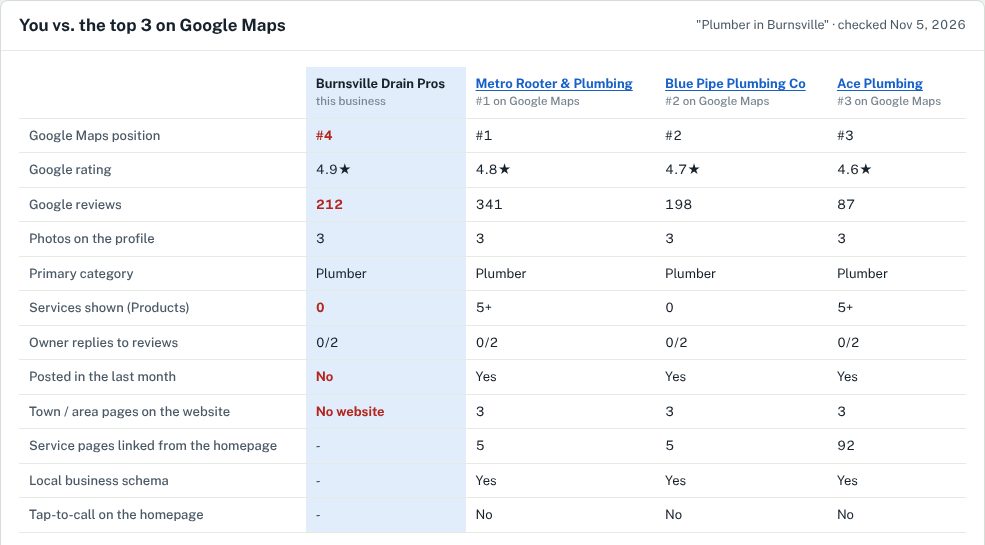
In AAM SEO Checker, every Google profile audit does this automatically. It searches Google Maps for "main category in town", finds where your business sits, and reads the top three the same way it read yours. You can change the search phrase and press Compare again, because rankings change a lot with the wording: "best realtor in Islamabad" and "real estate agent in Islamabad" can give different top threes.
Step 2: Work through the usual reasons
Distance
If the businesses above are all clustered near the centre of town and yours is 9 km out, distance explains a lot, and the address can't move. Win on everything else, and add a strong page on the website for the town you want to rank in. Remember rankings also change with where the searcher is standing, so check from a few spots before judging.
Primary category
If the top three all use "Plumber" and yours uses "Plumbing supply store", that alone can keep it out of the pack. Change one category at a time and give it a few weeks.
Keywords in competitors' names
"Burnsville Emergency Plumber 24/7" will often rank well for "emergency plumber Burnsville". If that's the real registered name, it's legitimate. If it isn't, Google's guidelines don't allow it (Google's guidelines), and you can suggest an edit on the listing. Don't respond by adding keywords to your own name.
Open when the search happened
Businesses that are open at the time of the search tend to show up higher, so competitors open 24 hours often appear at night when your client doesn't. Check the hours are complete, and add longer hours only if the business really works them.
Reviews: recency and pattern, not just count
A steady stream of recent reviews matters as well as the total. Watch for odd patterns on competitors too, such as many five-star reviews with no text arriving in the same week, which can point to bought reviews.
Services, posts, photos and replies
Services listed as Products, a post in the last month, recent photos and replies to reviews are all small signals that add up. The comparison shows at a glance which ones the top three have and your client doesn't.
The website
The website the profile links to feeds relevance: does the homepage title name the service and town? Is there a page for each service and each town? Is there LocalBusiness schema? A business with no website, or one that doesn't load, gives Google much less to go on.
Step 3: Let the tool write the "why"
Under the comparison, AAM SEO Checker lists why they rank above you, most important reason first, each with a plain-language explanation and what to do about it. It checks distance, categories, names, opening hours, review counts, recency and patterns, photos, posts, replies, services and the website.
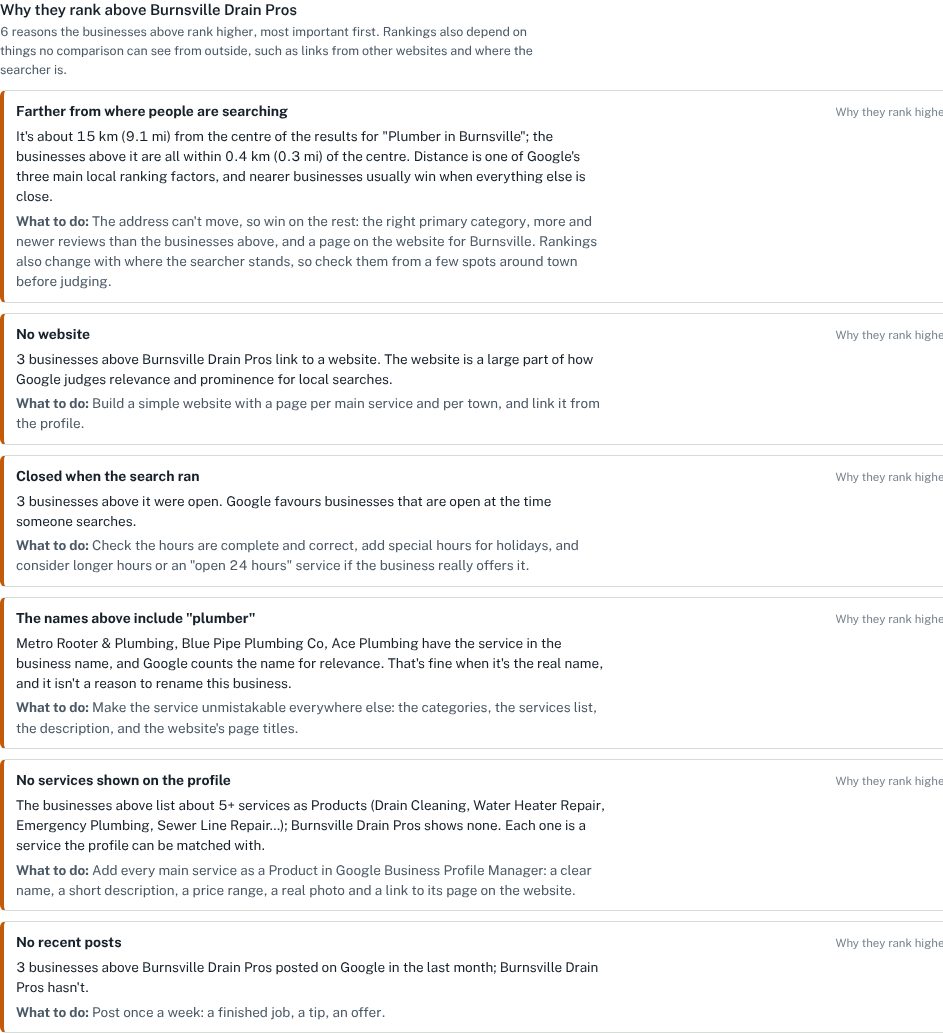
When your client beats the top three on everything the comparison can see, the tool says so and points to what's left: the website (titles, town and service pages, schema) and things no outside comparison can measure, such as links from other websites. That's often the moment to audit the website properly.
Step 4: Show the owner
The comparison, the reasons and a screenshot of Google's own map results with the business outlined in red all go into the client report. An owner who sees their business at #4 next to three competitors, with the gaps in red and a fix beside each one, doesn't need convincing that there's work to do.
Questions
Why does my client rank differently when I search myself?+
Local results depend on where the searcher is and the exact words they use. Check from a few locations and with the phrases customers actually type, not just the business's own name.
How many competitors does the comparison include?+
The top three on Google Maps for the search phrase. The free plan shows the #1 competitor; Pro shows all three, in the app and in every report.
Can the comparison see backlinks?+
No. It compares what's visible on the profiles and websites. When everything visible is in your client's favour, the tool points to the website and to factors like links that need separate checks.